
Why additionality varies across superpollutant projects
November 12, 2026 - Research
In carbon market conversations, additionality is one of the fundamental principles that governs evaluation of greenhouse gas integrity. In this edition of our superpollutant series, we take a closer look at additionality across superpollutant projects. For a refresh on the basics of additionality, check out this blog.
What is additionality?
An additional carbon credit represents an emission reduction or removal that would not have happened anyway. To assess this, we ask whether the activity is already required by law, is common practice, or makes financial sense without carbon revenue. This matters because credits used to compensate for someone’s emissions need to deliver a climate benefit beyond business as usual.
This principle is fundamental to offsetting, since using carbon credits is meant to compensate for the users emissions and should therefore represent tonnes of greenhouse gas reductions that go above and beyond (i.e., they are ‘additional’ to) a business-as-usual scenario.
Additionality varies across superpollutant project types
Superpollutant credits may be perceived as having lower additionality risk than other project types. The logic is intuitive, particularly for activities that destroy a potent gas like methane or a refrigerant and generate no revenue. In such cases, carbon finance is often the main reason it happens. However, superpollutants cover a wide range of gases, sectors and geographies, and additionality is not guaranteed across all of them.
Here’s a look at non-additionality risk across superpollutant projects compared to all other project types rated by Calyx Global:
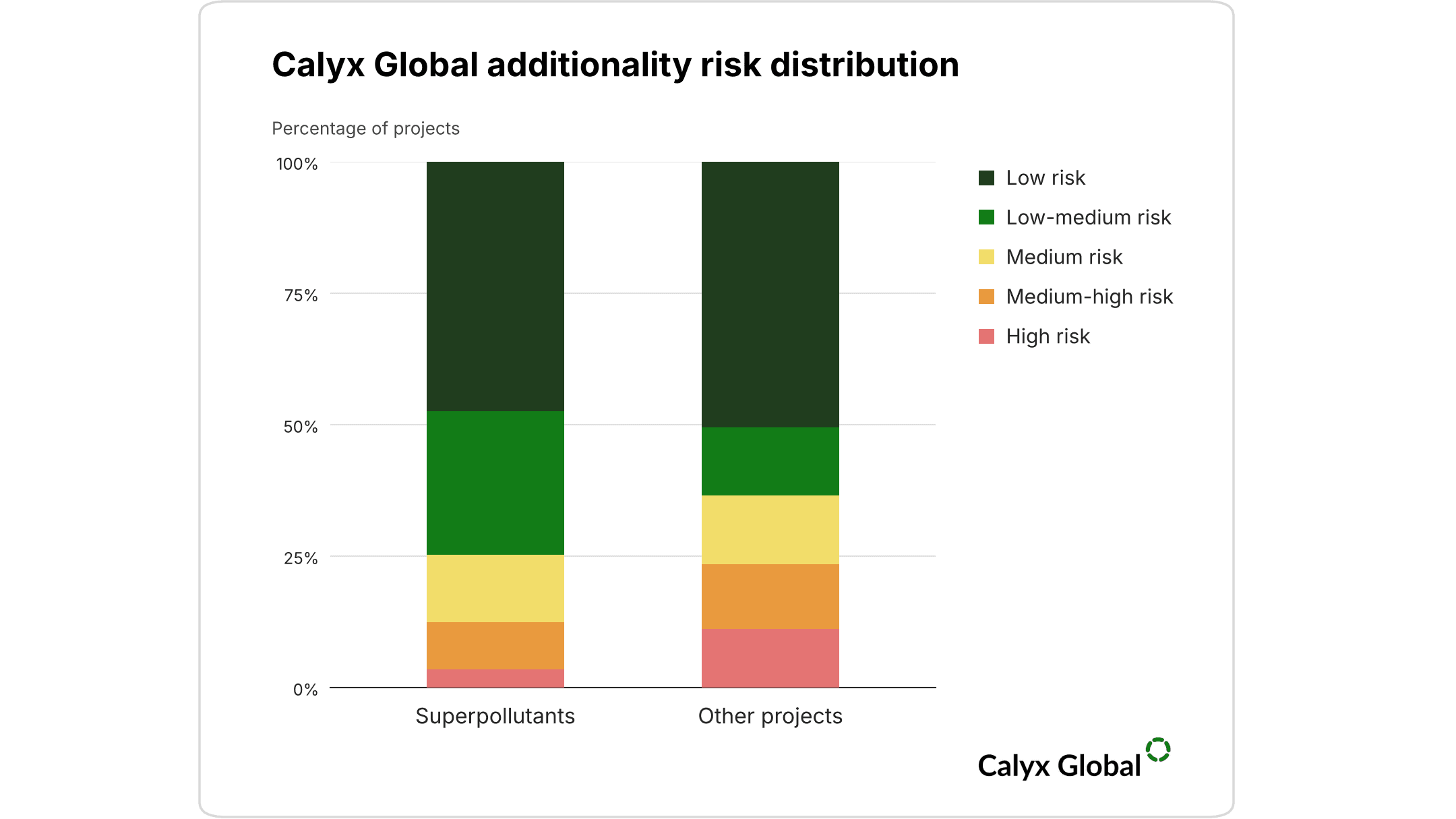
Across the gamut of superpollutant projects, additionality can be demonstrated by a variety of factors. For some project types, demonstrating additionality is straightforward. For example, destroying ozone-depleting substances (ODS) is unlikely to occur under baseline practices, particularly where not required by regulation, since there is no economic incentive to do so. For other project types, energy revenues, cost savings or established industry practices may make the case for additionality less clear.
Here are key factors that help determine additionality for each project type:
| Project type | Key factors for assessing additionality |
| Leak detection and repair (LDAR) | Ownership and financial structures: Projects should demonstrate financial need since repairing leaks across oil and gas infrastructure increases value (less leaking gas) for the company; however, a lack of regulation and LDAR practices can support additionality. |
| ODS and HFC destruction | Regulation, funding sources: Destruction is rarely required by regulation; however, subsidies or financial support for destruction are sometimes provided by governments or donors. |
| Landfill gas and manure management | Revenue sources, policy-driven incentives: Flaring does not generate revenue, but providing methane to the grid can make a project viable without carbon finance; policy support or community pressure may also make this activity common practice and put in question additionality |
| Orphaned well plugging | Regulation, subsidy support: Most of these projects are in the United States where there is no regulation to plug such wells; however, there are subsidies available that should be checked |
| Mine methane | Regulation, other revenue sources: Enforcement of methane rules at active or abandoned mines varies by jurisdiction; where gas is flared, there is no economic incentive, however the methane may be used to generate energy revenue. |
| HFC replacement | Financial conditions, regulatory and market transitions: Switching to lower-GWP gases has been underway and, in some cases, HFC replacement may be financially sensible without carbon credits depending on the location. |
For more information on key drivers of additionality across project types, ask us about Calyx Compass.
Additionality can vary within a project type: the case of landfill gas
Additionality also depends on the circumstances of each project. The landfill gas example below shows how differences in project costs, revenues and other incentives can affect confidence that an activity goes beyond business as usual.
Landfill gas projects involve the capture of methane gas from landfills, which is either destroyed by flaring or utilized to generate electricity, heat or renewable natural gas (RNG). Across landfill gas projects, a range in the confidence of additionality can be observed. Strong evidence of additionality may be provided when projects demonstrate a need for financial support from carbon credits. This may involve a financial analysis that considers project costs, revenue from electricity or gas sales, and other financial incentives, such as feed-in tariffs.
For projects that do not utilize the captured gas to generate energy, additionality may be clearer since there are typically no financial benefits. However, in some cases, for example in more developed countries like the United States, there may be other motivations behind the implementation of flaring projects, such as safety or odor concerns.
Regulation can make an activity non-additional
Additionality can change as regulations evolve. An activity that carbon finance helps make possible today may later be required by law. Growing government attention to superpollutants, including commitments in climate plans and nationally determined contributions (NDCs), could lead to new requirements in sectors where carbon projects operate. If those requirements cover the activity being credited and are enforced, the activity may no longer be additional, and continued crediting would need to be reassessed.
Take, for example, the case of advanced leak detection and repair (LDAR) programs in Bangladesh. The majority of LDAR activities remain unregulated in Bangladesh, and may not be prioritized under the operational and financial constraints of existing facilities, which are further complicated by financial structures governing the state-owned network operators. If carbon credits were never introduced, it is likely that fugitive leaks would remain unmanaged through the present day.
On the other hand, in countries like the U.S., there may be stronger enforcement of leak detection programs, and an impetus from private companies to reduce gas leaks. In these circumstances, additionality is harder to prove, especially if robust procedures are already in place to measure leaks. Resources like the Global Methane Hub track the current status of regulation across emitting sectors globally.
Additionality may be temporary
Carbon finance can help put existing technologies into practice where costs or other barriers would otherwise prevent implementation. But the conditions that support additionality can change. New regulations, other funding sources or wider adoption of an activity may change what would happen without carbon finance.
Bangladesh can serve as an example. Leak repair is now mentioned as a climate mitigation strategy to pursue in Bangladesh’s Nationally Determined Contributions, which notes carbon credit projects as a pathway to enable these activities. If these commitments are later translated into legally-binding requirements to reduce leaks, then carbon credits will no longer be needed to ‘bridge the gap’. Continuous review of conditions outside of carbon market activities, paired with close review of project-specific conditions, can provide key information to assess whether projects are additional.
Conclusion: If additional, superpollutant credits punch above their weight
Not all superpollutant credits are additional, but many are. These credits have outsized warming impact over a short time horizon, making them especially valuable for near-term climate action. Furthermore, the role they can play in supporting future regulation suggests such credits bring value beyond simply one tonne of CO2-equivalent reduced from the atmosphere.
Keep up with carbon market trends
Get the monthly newsletter and stay in the loop.
Trusted By






Next Up

Ready for regulation: what EU oversight means for Calyx Global
November 2, 2026

Webinar On-Demand: The New Age of REDD+: What's reshaping the next generation of forest carbon projects?
October 28, 2026
Why GWP matters for superpollutant credits: When small changes can have a big impact
October 20, 2026